In Japan’s waste paper recycling industry, space utilization is a real concern for many customers. Compared with markets where land resources are more flexible, many recycling stations, packaging waste processing sites, printing factories, and logistics warehouses in Japan have limited working space. Waste paper, cardboard, and paperboard are bulky materials. If they are not compressed in time, they can quickly create site congestion and affect sorting, handling, loading, and daily management.
Therefore, Japanese customers should not choose a waste paper baler only by pressure or price. The more important question is whether the machine fits the customer’s site, material, capacity, and transportation method. A properly selected horizontal waste paper baler can greatly improve paper recycling efficiency in limited space.
Why Do Japanese Waste Paper Recycling Stations Face Space Pressure?
Japan has a mature waste paper recycling system, and the collection channels for cardboard, office paper, packaging paper, and paperboard are relatively stable. For recycling companies, this means that materials arrive continuously, and the site must process them efficiently every day.
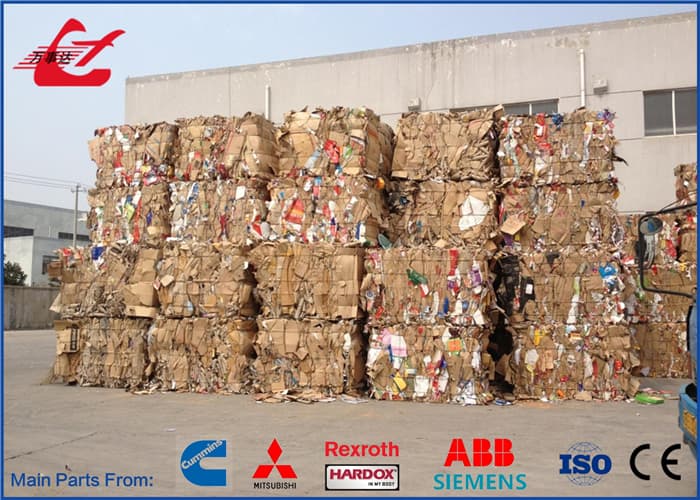
In supermarkets, logistics parks, packaging factories, and urban recycling stations, cardboard is usually one of the most space-consuming materials. Before compression, cardboard is very bulky. Even if the weight is not very high, it can occupy a large warehouse area. If the site is limited, waste paper piles may quickly affect forklift lanes, operator areas, and truck loading zones.
Japanese customers also usually have high expectations for site cleanliness, safety, and management efficiency. Too much loose waste paper may affect visual management and increase fire risk, handling risk, and site management difficulty. Therefore, the value of a waste paper baler in Japan is not only higher output, but also a cleaner, safer, and more controllable recycling workflow.
Which Japanese Customers Are Suitable for a Horizontal Waste Paper Baler?
A horizontal waste paper baler is more suitable for customers with stable waste paper volume, continuous processing needs, and higher requirements for bale density and truck loading efficiency. Waste paper recycling stations, packaging factories, printing factories, logistics warehouses, e-commerce packaging waste processors, and waste paper traders can all consider this type of machine based on their real working conditions.
If the customer only handles a small amount of waste paper every day and has very limited space, a Vertical Baler or Vertical Baler Machine may be considered. These machines have a smaller footprint and are suitable for low-capacity operations.
However, if the customer handles larger volumes of cardboard, paperboard, and packaging paper every day, and wants to reduce manual handling, improve bale discharge efficiency, and produce bales that are easier to load and stack, a horizontal waste paper baler is usually more suitable. A 125 ton waste paper baler offers a good balance between processing capacity, investment cost, and site adaptability for many small and medium-sized Japanese recycling customers.
What Key Points Should Customers Check Before Choosing a Horizontal Baler?
First, customers should check the material type. Cardboard, paperboard, office paper, printing waste, and packaging paper scraps have different bulk density and compression results. If the customer also handles plastic film, woven bags, or soft packaging materials, the design concept of a Plastic recycling baler may be useful for selecting a better feeding and compression solution for light materials.
Second, customers should consider daily capacity. Different recycling sites have very different processing volumes. A small recycling station may only handle a small amount of cardboard every day, while a packaging factory or logistics warehouse may generate large volumes of packaging waste. Higher capacity requires better compression efficiency, stronger hydraulic configuration, and better continuous operation ability.
Third, site layout must be considered. A horizontal baler requires space for feeding, bale discharge, forklift movement, maintenance, and the electrical control cabinet. If the site is narrow, the bale discharge direction and machine placement are very important. It is better to confirm the site dimensions before ordering the machine.
Fourth, bale size should match the customer’s logistics process. Japanese customers usually pay close attention to handling and stacking efficiency. The bale size should be suitable for forklift handling, warehouse stacking, and truck loading. If the bale is too loose or the size is not suitable, transportation may still create extra cost.
Fifth, maintenance convenience is important. A waste paper baler is long-term equipment. The hydraulic system, electrical system, oil pipes, seals, and wearing parts all need maintenance during use. Choosing a clear-structure and reliable hydraulic waste baler can reduce downtime and improve long-term value.
Why Is a 125 Ton Horizontal Waste Paper Baler Suitable for Small and Medium-Sized Recycling Stations in Japan?
The advantage of a 125 ton horizontal waste paper baler is that it is neither too small for efficient processing nor as costly as a large automatic baling line. For small and medium-sized waste paper recycling stations in Japan, it can meet the compression needs of cardboard, paperboard, packaging paper, and commercial waste paper while keeping the equipment investment relatively reasonable.
This machine can compress loose waste paper into more regular bales, allowing customers to make better use of warehouse space. For Japanese customers with limited space, reducing site congestion is already a very important value.
The horizontal structure is also more suitable for continuous feeding and batch processing. If the customer has stable material sources such as supermarket cardboard, logistics cartons, printing factory scraps, or packaging factory waste, a 125 ton waste paper baler can improve daily processing efficiency and reduce manual sorting time.
Our Recommendation
For Japanese customers, if the current problems are bulky waste paper, slow manual sorting, and low truck loading efficiency, a 125 ton horizontal waste paper baler can be considered first. If the processing volume is small, a vertical baler may be enough. If the processing volume is large or a higher level of automation is required, a higher-pressure machine, larger chamber, or conveyor feeding system can be customized.
We can provide selection suggestions based on customer material photos, daily capacity, site dimensions, voltage requirements, and bale size needs. With around 40 years of experience in hydraulic machinery manufacturing, our engineering team can provide customized machine design. Supported by CE and ISO9001 certification, we provide reliable equipment and export service for overseas customers.
News Summary
When choosing a horizontal waste paper baler in Japan, customers should not focus on one single parameter only. The key is whether the machine truly matches the working site. A suitable waste paper baler can help customers reduce waste paper storage space, improve truck loading efficiency, lower manual handling pressure, and make the recycling workflow more stable.
For Japanese customers who handle cardboard, paperboard, packaging paper, and commercial waste paper, a 125 ton horizontal waste paper baler is a practical medium-capacity solution worth considering.